

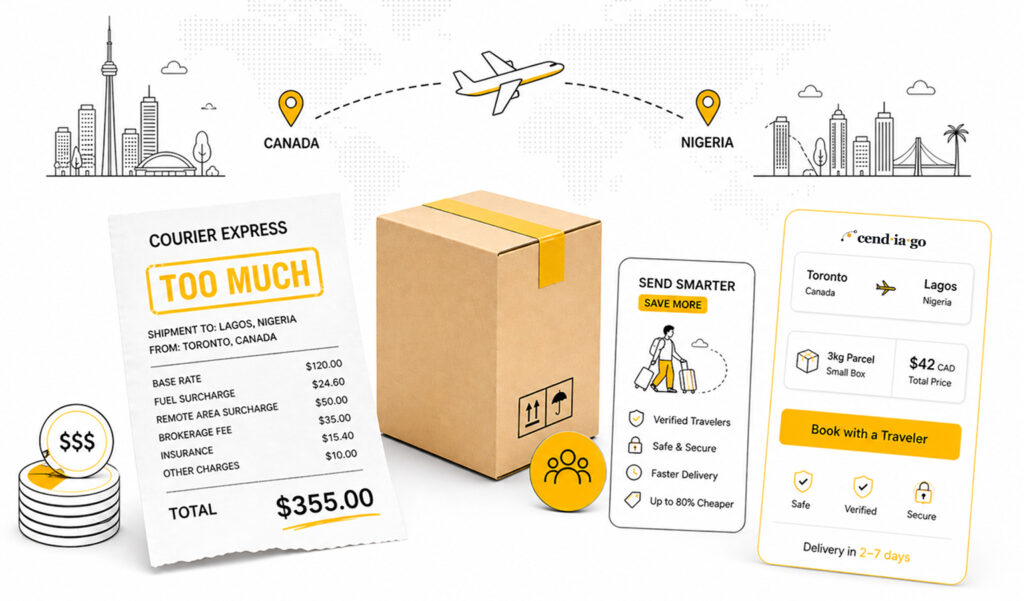
You go online to send a small box of medicine and two t-shirts to your mum in Lagos. You type in the dimensions, the weight, the postcode. You hit get a quote.
The number that comes back is $355.
For a shoebox.
If you’ve ever had this moment — staring at a courier checkout, doing the mental math on whether your mum really needs that asthma inhaler this month — this post is for you. We pulled together every line item, every surcharge, every hidden fee that goes into the cost of sending a parcel from Canada to Nigeria in 2026, and then we’ll show you the option most diaspora families don’t know exists yet.
TL;DR
- DHL Express from Canada to Nigeria runs roughly CA$278 for a small envelope and CA$481+ for a shoebox-sized package, before customs charges to the recipient.
- The headline price is rarely the final price. Fuel surcharges, “remote area” fees, brokerage, and insurance add up fast.
- A traveler-courier model — sending parcels with verified travelers who already have a flight booked on your route — costs roughly CA$30–60 for the same shoebox, with money held safely in escrow until delivery is confirmed.
- This is what cend·ia·go is being built for, launching Summer 2026.
What does DHL actually charge to ship to Nigeria?
Let’s start with the most common quote diaspora families get. DHL Express is the de facto standard for Canada-to-Nigeria shipments because the postal options are slow and FedEx doesn’t have the same African network depth. Here’s what real DHL pricing looks like in 2026:
|
Package type |
Approx. cost (CAD) |
Transit time |
|
Small envelope (documents) |
$277.50 |
4 days |
|
Book-sized box (1–2 kg) |
$277.50 |
4 days |
|
Shoebox-sized box (3–4 kg) |
$481.51 |
4 days |
|
Larger box (5+ kg) |
$600+ |
4–6 days |
Source: DHL Canada → Nigeria pricing data via Klickship’s 2026 rate tables.
The thing nobody tells you on the homepage is that DHL doesn’t price by weight alone. It uses volumetric weight — basically (length × width × height) ÷ 5000 — and charges you on whichever number is higher. This is why a shoebox of feathers costs the same as a shoebox of bricks. The box itself is the problem.
The hidden surcharges nobody warns you about
When you see a “$120” base rate, that’s the rate before:
- Fuel surcharge — typically 15–25% on top of the base rate, recalculated monthly. On a $120 shipment, that’s another $18–30.
- Remote area surcharge — Lagos is fine. Most of Nigeria is not. If your recipient is outside Lagos, Abuja, or Port Harcourt, expect another $40–60.
- Customs brokerage — DHL charges to clear your package through Nigerian customs. Often $25–50.
- Insurance — Optional, but most people opt in for medicine and electronics. Add another 1–3% of declared value.
- Signature on delivery — Standard for international, often baked in but sometimes extra.
This is exactly how a “$120” envelope becomes a $355 final receipt. And it’s why the homepage of cend·ia·go opens with a torn DHL receipt stamped “too much.” It’s not a marketing exaggeration. It’s the median experience.
“I’ll just ask my cousin who’s flying next week”
So you skip the courier and try option B: ask a friend.
Every diaspora family has a version of this conversation:
Hey — random ask. You’re flying to Lagos next week right? Any chance you could take a small box for my mum?
It works sometimes. But it’s awkward, and there’s no recourse. If the parcel doesn’t make it, what are you going to do — sue your cousin’s coworker? You owe them a favor you may never get to repay. The traveler often feels weird about asking for money. Nobody knows whose responsibility it is if customs holds the bag at Lagos arrivals. And if the parcel just… doesn’t arrive, you have nothing to fall back on except a bad WhatsApp conversation.
The friend route is cheap but socially expensive. The courier route is financially expensive but emotionally easy. Most people end up alternating between the two, depending on what they’re sending and how desperate they are.
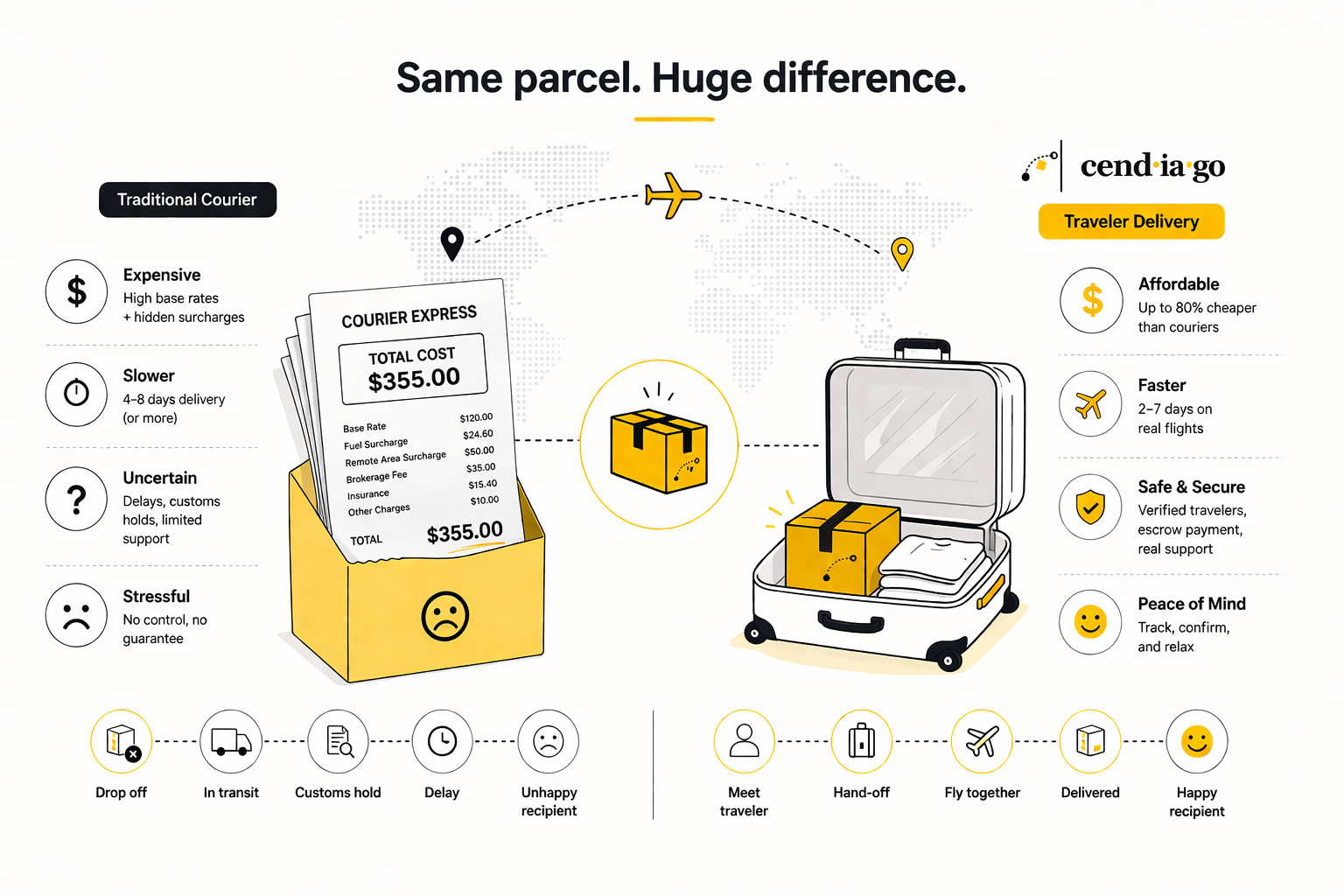
The third way: travelers who are already flying your route
Here’s the gap nobody has filled at scale: roughly 1.4 million people fly between Canada and Nigeria every year, and the vast majority of them have empty space in their checked bags. A 23kg luggage allowance is rarely fully used, especially on the outbound leg.
That’s a lot of unused capacity flying overhead while diaspora families pay $355 to send a 3kg box on a different plane.
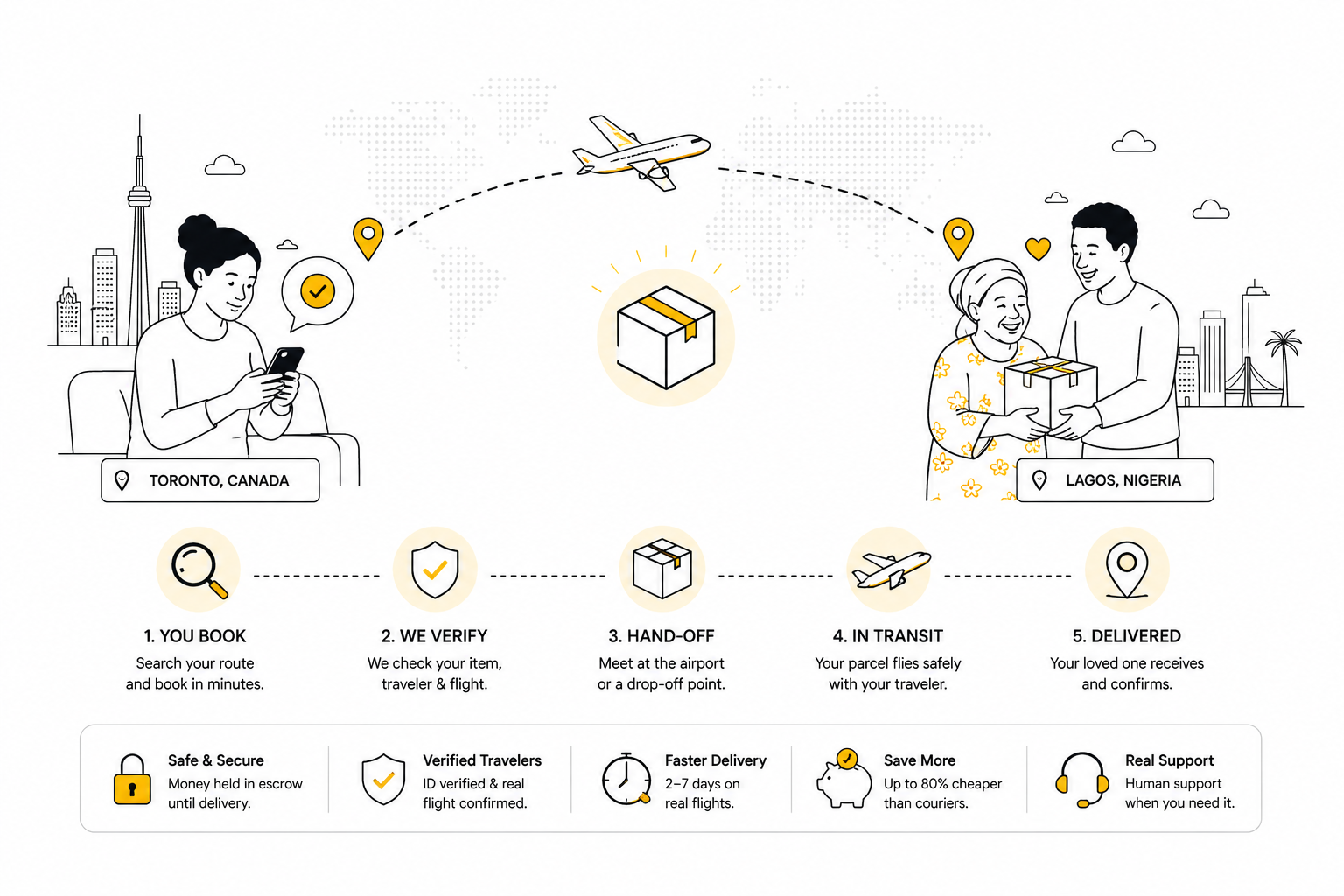
The traveler-courier model — which is what cend·ia·go is built around — works like this:
- Search by route and date. You see verified travelers heading from your city to your destination, with their flight already booked.
- Match. You tell them what you’re sending. The system checks customs rules instantly and flags anything that won’t clear.
- Pay safely. Your money goes into escrow. The traveler doesn’t see a cent until your family confirms delivery.
- Hand-off, fly, confirm. You meet at the airport (or use a drop-off point). They carry it on their flight. Your family picks it up on the other side and confirms. Everyone gets paid.
The price difference is dramatic. A typical Toronto → Lagos trip on cend·ia·go is priced around CA$42 for a 3kg parcel — roughly 88% cheaper than DHL’s $355 equivalent. Travelers earn $50–180 per trip for space they were going to fly with empty anyway. Senders save hundreds. The recipient gets their parcel in 2–7 days on a real, scheduled flight.
“Is this even legal?”
This is the question we get most often, so let’s address it directly. Yes — carrying a parcel for someone else is legal as long as the contents are legal and properly declared. People do this informally every day; the platform just makes it safer and accountable.
What cend·ia·go adds on top:
- ID verification for every traveler, plus flight booking confirmation
- Automatic customs check before booking — if you can’t legally send it, the system tells you before you pay
- Photo proof at hand-off, so both parties have a record of what was carried
- Escrow — the traveler doesn’t get paid until delivery is confirmed, which means there’s an actual financial incentive for the parcel to make it
- Real human support if anything goes wrong
You can’t send anything you couldn’t already send through DHL — no controlled substances, no prohibited items, no undeclared cash. The customs check happens before you book, not after the parcel arrives.
What can you actually send?
The most common parcels diaspora senders move on this corridor:
- Medicine and prescriptions (with proper documentation)
- Documents (passports, certificates, signed paperwork)
- Clothes and gifts (especially around weddings, holidays, and naming ceremonies)
- Phones and small electronics
- Specialty foods that are hard to find at home
What you can’t send is the same list as any courier: no liquids over limits, no flammables, no controlled substances, no live animals, no undeclared cash above customs limits.
Side-by-side: the real cost comparison
For a 3kg shoebox going from Toronto to Lagos, here’s what the three options actually look like:
|
Factor |
DHL Express |
A friend flying |
cend·ia·go (traveler) |
|
Cost |
~CA$355 |
$0 — but awkward |
~CA$42 |
|
Transit time |
4–6 days |
Whenever they go |
2–7 days |
|
Verification |
Corporate |
Personal trust |
ID + flight verified |
|
Money protection |
Refunds rare |
None |
Held in escrow |
|
Customs check |
After you pay |
None |
Before you book |
|
Recourse if it fails |
Limited claims |
A bad text chain |
Full support + refund |
So who is this actually for?
If you live in Toronto, Calgary, Montreal, or Vancouver and you have family in Lagos, Abuja, Port Harcourt, or Ibadan, this corridor was built for you. The same pattern works for the UK → Nigeria, US → Nigeria, and Canada → Ghana / Kenya / Philippines / India / Pakistan corridors — anywhere there’s a strong diaspora community and high airline traffic going both ways.
The reality is this: sending a package home shouldn’t cost more than the package itself. And asking a stranger for help shouldn’t feel like begging.
When does cend·ia·go launch?
We’re launching Summer 2026, starting with 12 cities and 42 routes — including Toronto ↔ Lagos, Toronto ↔ London, and several other major diaspora corridors. New routes go live every week as more travelers verify.
If you want first access — and a chance to send your first parcel before public launch — join the waitlist. It takes 30 seconds, and we’ll email you the moment your route opens.
Frequently asked questions
How much does it cost to send a parcel from Canada to Nigeria?
Through DHL Express, expect roughly CA$278 for a small envelope and CA$481+ for a shoebox-sized package, plus customs charges to the recipient. Through cend·ia·go’s traveler-courier model, the same shoebox costs around CA$42.
What’s the cheapest way to send a box to Nigeria from Canada?
Standard postal options are the cheapest listed rate but often take 4–8 weeks and offer no tracking past Canada. The cheapest fast option is the traveler-courier model — typically 80% less than DHL with 2–7 day delivery on a real flight.
Is it safe to send medicine to Nigeria with a traveler?
Yes, as long as the medicine is legal, properly labeled, and accompanied by documentation. The cend·ia·go customs check verifies this before you pay. We recommend always including a copy of the prescription.
Can I send cash with a traveler?
No — for the same reason DHL won’t carry cash. Undeclared cash above customs limits is illegal in most jurisdictions. Use a remittance service (Wise, Remitly, etc.) for money transfers.
How does cend·ia·go protect senders?
Every traveler is ID-verified with their flight booking confirmed. Money is held in escrow and only released after the recipient confirms delivery. Travelers take photos at hand-off. If anything goes wrong, real human support reviews the case and resolves it.